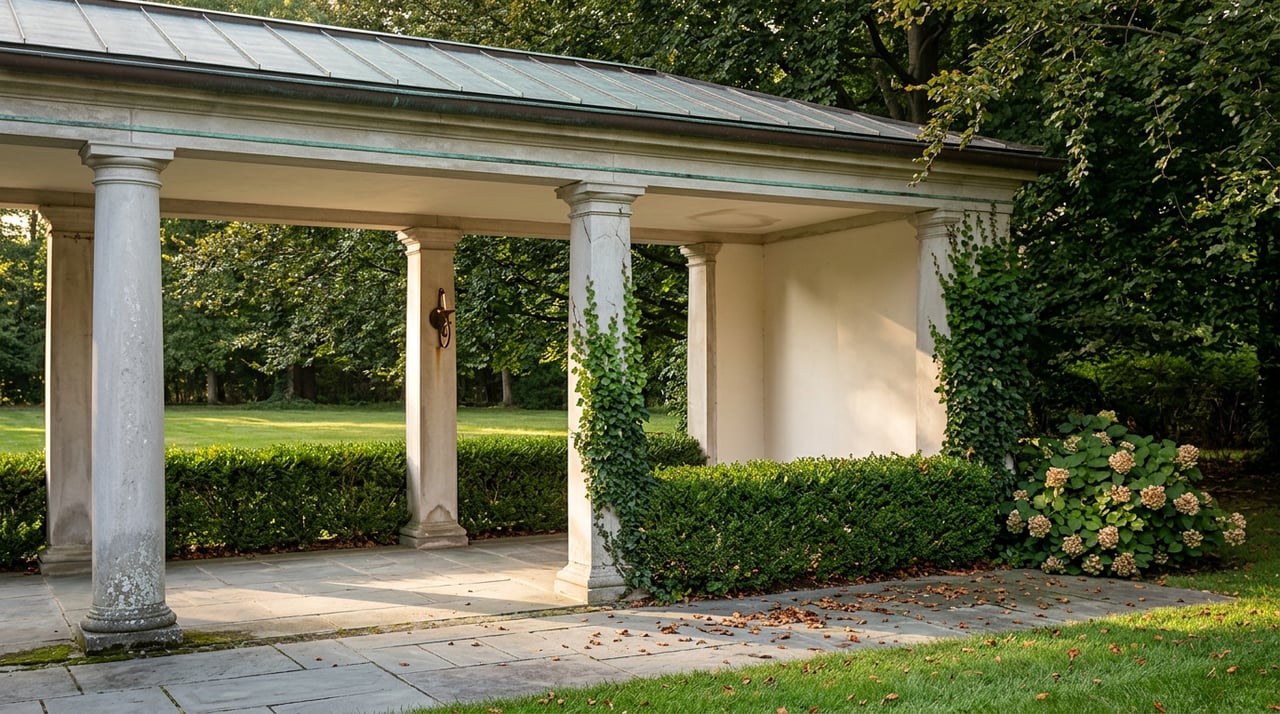
What’s New at Caumsett State Park in Lloyd Harbor
August 20, 2026
August 20, 2026
In 1917, Roland Conklin built an open-air theater on his Rosemary Farm estate as a gift to his wife, the opera singer Mary MacFadden. That summer it hosted the National Red Cross Pageant, a benefit that raised fifty thousand dollars and drew a cast that included John, Lionel, and Ethel Barrymore. For decades after, the estate passed to the Diocese of Brooklyn, became the Seminary of the Immaculate Conception, trained priests for nearly ninety years, and eventually let its grandest architectural feature go quiet. When the main house burned in 1990 after standing abandoned, most of it came down. The amphitheater survived as a ruin: overgrown, off limits, a footnote in local history that longtime residents knew about mostly by rumor.
This year it reopened as a place you can actually walk to and sit in.
That single fact, more than any acreage figure attached to the Caumsett expansion, is the news that matters if you already live here. The land deal that made it possible has been in motion since at least 2021, when the North Shore Land Alliance first described a three-way agreement among the Seminary, New York State, and the Village of Lloyd Harbor to split the property's 216 acres. Coverage at the time said the sale was expected to close in early 2024. It didn't. Governor Hochul's office didn't announce the finished 180-acre addition to Caumsett State Historic Park Preserve until January 2026, two years after most residents assumed the paperwork was done. If you stopped paying attention after the first round of headlines, you missed the part where it actually happened.
The Seminary property split three ways, and each piece is doing something different:
That split explains why the expansion doesn't feel like new trails opening up. The 180 acres that went to the state are managed as habitat, not recreation infrastructure. It's the kind of terrain that's good for birders and quiet walkers but wasn't built for the paved loops and packed-dirt paths you already know from the older section of the park. If you were expecting a new trailhead sign this spring, you're not going to find one yet. What you get instead is a permanent guarantee that this particular stretch of woods and wetlands, the kind that developers had circled for housing tracts before the deal came together, stays undeveloped for good.
The 20 acres the Village bought are the ones that changed things you can actually use.
The Huntington Historical Society reported this spring that the Conklin amphitheater has been restored. It now sits on Village-owned land rather than semi-abandoned seminary property, and the Caumsett Foundation has started building programming around it. The Foundation's 2026 roster includes an Artist in Residence program with printmaking workshops led by Luanda Lozano, focused on relief printing and blind embossing using both traditional plates and materials found on the grounds, and a separate residency with Heather Heckel built around layered compositions inspired by the property. There's a sound bath meditation held in the Walled Garden, twenty dollars for non-members and free for Foundation members. Musical programming has included performers like the Long Island indie-folk band Star Harbor and singer-songwriter Derek Adam, plus a more classical pairing of NYC-based pianist Michele Wong and bass-baritone Detola Badmus, a Long Island native.
None of that existed as a public draw two years ago. The amphitheater was a ruin you weren't supposed to enter. Now it's booked with a season of programming that didn't have a stage to happen on before.
A few smaller shifts are worth knowing if you're already in the habit of walking, boating, or driving through the village.
Fishermans Road tightened up. As of April 1, the road and its parking area are open to annual permit holders only. If you used to park there without one, that window closed this spring.
The police department temporarily moved. Construction began at the Lloyd Harbor Police Department building, and its offices are operating out of the Seminary of the Immaculate Conception at 440 West Neck Road for the duration. The phone numbers didn't change, just the address.
The café season is running on its usual clock. Caumsett Café is open Friday through Sunday, 9 a.m. to 5 p.m., May through October, same as it has been. If you're timing a walk around a coffee stop, weekdays still won't work.
Here's the shorthand version of what actually moved and what stayed put:
| What | Before | Now |
|---|---|---|
| Seminary's 216 acres | Threatened by development interest, agreement pending since 2021 | Split three ways, state's 180 acres finalized January 2026 |
| Conklin amphitheater | Overgrown ruin, off limits | Restored, hosting Foundation concerts and residencies |
| Fishermans Road parking | Open to the public | Permit holders only, effective April 1 |
| LHPD offices | Village Hall complex | Temporarily at the Seminary building during construction |
If you've lived here long enough, you already know Lloyd Harbor runs on a rhythm most visitors miss entirely. The Lloyd Harbor Yacht Club opens its racing season each year with the Race for the Case, where the winning boat takes home a case of rum and the after-party moves to Huntington Yacht Club for a buffet and cash bar. A few weeks later comes the Huntington Bay Championship, which combines the 132nd running of HYC's Huntington Day Race with the 60th running of LHYC's own Lloyd's Trophy, staged in the water off Lloyd Neck near Nun 6. The season closes out its early stretch with the members-only Commodore's Cup, a jib-and-main race with no spinnakers allowed. None of this shows up on a typical visitor's radar. It's calendar knowledge that only comes from actually being here summer after summer.
The Lloyd Harbor Historical Society runs on a similar quiet cadence, holding its seasonal programs out of the Henry Lloyd Manor house, built in 1711 and one of the oldest structures on the peninsula. It sits inside Caumsett's boundary, a few hundred yards from the amphitheater that just came back to life, offering historic interpretation of colonial life to whoever wanders in during open hours.
Put it all together and the picture that emerges isn't really about new acreage. It's about a threatened piece of land finally getting locked into permanent protection two years later than the headlines suggested, and a century-old stage that sat empty for decades suddenly filling back up with printmaking workshops and sound baths. Those two things happened almost simultaneously in 2026, and neither one required a single new trail marker to matter.
If you're the kind of resident who already has the café's Friday hours memorized and knows which Saturday in June belongs to the yacht club, this is the update that actually changes something. The rest of the park looks the same. The stage doesn't.
Questions about anything happening in the neighborhood, from the park to the harbor to what's next door, are always welcome. Jamie Marcantonio has spent more than three decades paying attention to the small changes that make Lloyd Harbor what it is. Let's Connect.
Stay up to date on the latest real estate trends.
You’ll benefit from Jamie’s expertise in luxury and waterfront homes across Long Island, as she guides you with market knowledge, strategic pricing, and personalized service to make your buying or selling experience smooth and successful.
GET IN TOUCH TO LEARN MORE

157 E MAIN ST HUNTINGTON, NY 11743